

One MPN Family: YouTube Videos, Summary & Highlights from the 5th MPN Spring Symposium
- Dec 10, 2025
- 9 min read
Three Unforgettable Days as One MPN Family
From 7 to 9 November 2025, Barcelona hosted the 5th MPN Spring Symposium, organized by the Global MPN Scientific Foundation (GMPNSF).
More than 50 people attended in person, over 100 followed live via Zoom, and participants joined from China, Saudi Arabia, Portugal, the USA, Canada, Europe, and Latin America. For the first time, we had a large in-person roundtable with more than 8 young patients (AYAs) from different countries. In total, 7 young AYAs traveled from abroad to share their experience face-to-face.
What defined this meeting was not only the science, but the feeling of a true MPN family: patients, caregivers, nurses, physicians, researchers and pharmaceutical partners, together in one room, listening to each other and building bridges.

Content guide
New: MPN Symposium Videos Now on the GMPNSF YouTube Channel
We are excited to announce the launch of the GMPNSF YouTube channel, now hosting all our educational MPN videos.
The full video collection from the 5th MPN Spring Symposium is now available, including expert talks, patient testimonies and the AYA Roundtable.
Day 1 – Clinical trials and global perspectives
Welcome and introductions
Peter Löffelhardt, CEO and Founder of the GMPNSF, officially welcomed all participants and underlined the core mission of the Foundation:
to connect Patients, Physicians and Pharma (the 3Ps)
to create spaces where patients feel safe to ask questions
and to ensure that scientific advances and real-life experiences meet in the same place.

Opening: POIESIS clinical trial for MF patients
The Symposium opened with a focus on clinical research. Prof. Serge Verstovsek (Physician-Scientist and a leading authority in the field of Myeloproliferative Neoplasms, USA) spoke about the POIESIS clinical trial for patients with Myelofibrosis (MF), exploring a new combination approach and why clinical trials are so important for the future of MPN care.

He explained in simple terms what the study is assessing, how patients are followed and how results could potentially influence options for people already on standard treatments.
MPNs in Saudi Arabia
In the session “MPNs in Saudi Arabia”, Dr. Marwan Shaheen (Head of Chronic Leukemia and Myeloproliferative Neoplasms Section in the Department of Hematology, SCT and Cellular Therapy at King Faisal Specialist Hospital and Research Centre- Riyadh, Saudi Arabia) and an MPN patient from Saudi Arabia shared how care is organized in their country, the challenges of accessing specialists and how international collaboration can help bring more information and new treatments to the region.
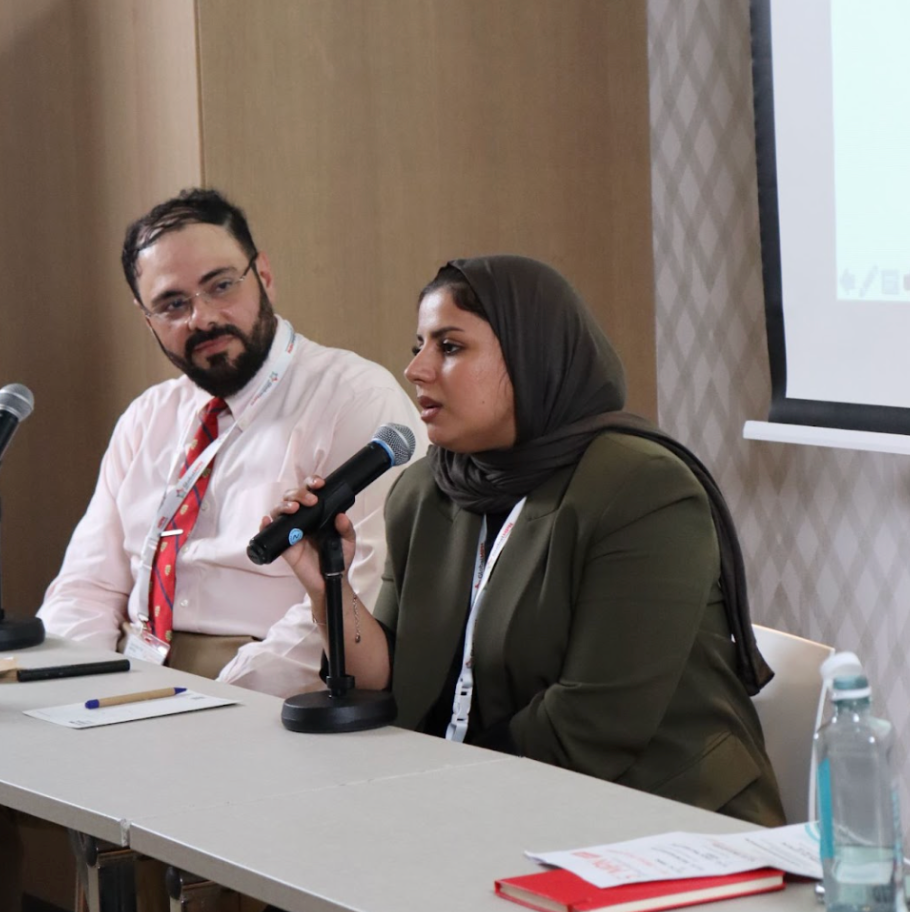
For many attendees, it was a powerful reminder that MPN reality is global, and that hearing from less-visible regions is crucial.
MPNs in the USA
Next, Dr. Joseph Shatzel (Hematologist at Oregon Health & Science University (OHSU) in Portland, USA) and patients from the USA discussed everyday life with MPNs in North America.
Topics included:
balancing treatment and work
managing fatigue and other symptoms
navigating insurance and healthcare systems

Their message was clear: access to information and specialized care can make a big difference in how patients live with the disease.
Nurse Navigation System in Barcelona
Later in the afternoon, Gabriela Aguirre, MPN Nurse Specialist at Hospital del Mar (Barcelona), presented the Nurse Navigation System for MPN patients. This project was founded by the Global MPN Scientific Foundation in collaboration with Hospital del Mar.
She explained how having a dedicated nurse can help patients:
understand their diagnosis and treatment
prepare questions before consultations
feel supported between medical visits

This session highlighted how nurses play a key role in helping patients feel less alone and more confident in their care.
MPN Journal: the importance of daily tracking
To close the day, John Hoogland, co-creator of MPN Journal, introduced this free and anonymous online tool designed by patients.

He showed how tracking symptoms, side effects and quality of life over time can:
help patients see patterns
support conversations with doctors
and, at the community level, contribute to research and understanding of MPNs.
Day 2 – Science, symptoms and international collaboration
Welcome and introductions
Day 2 started again with a short welcome from Peter Löffelhardt, setting the tone for a day focused on biology, symptoms, global projects and advocacy.

The biology of MPNs: expanded view and changing the perspective
In a deep, yet accessible session, Prof. Tata Nageswara Rao (Department of Oncology and Hematology, Health Ostschweiz (HOCH) Kantonsspital St.Gallen, Switzerland) walked participants through the biological mechanisms behind MPNs.

He spoke about:
how blood cells become abnormal
the role of inflammation and the bone marrow environment
and how certain markers (such as GDF15) may help detect fibrosis earlier and follow disease progression.
Understanding biology is not just a scientific exercise; it helps patients and clinicians see why treatments are designed the way they are and where new options might appear.
First contact with MPN in China
One of the most symbolic moments of the day was the session “First contact with MPN in China”, where participants from China shared how the community is starting to organize. It was a strong reminder that MPN challenges are shared worldwide and that connecting across borders can accelerate awareness and support.

Septembre Rouge
The day continued with Karin Tourmente from Vivre Avec une NMP (France) presenting “Septembre Rouge”, a national awareness campaign in France that is now expanding its reach.

The initiative aims to shine a light on blood cancers and MPNs every September and to mobilise patient organizations, clinicians and the general public.
How do we find MPN specialists?
In this practical and very well received session, Ulrike von Mickwitz from MPN-netzwerk (Germany) addressed a key question for many people: How do I find a doctor who really understands MPNs?

She shared strategies based on patient experience:
asking for referral to a center with MPN expertise
using patient networks and organisations
not being afraid to seek a second opinion when needed
The overall message: you are allowed to ask, you are allowed to search, and you are allowed to be an active partner in your care.
Afternoon: pharmaceutical companies
In the afternoon, we heard from representatives of two pharmaceutical companies who are actively working in the MPN field. Each presentation focused on their current research, ongoing clinical trials and how they see collaboration with patients and advocates as an essential part of progress.
The first presentation was given by Alberto Martínez, Senior Director of Clinical Science at Silence Therapeutics, who shared insights on RNA based approaches in MPNs and how patient-reported outcomes are increasingly being integrated into development strategies.
The second talk was led by Carmelo Alonso, Director, Global Medical Oncology, Myeloid (MDS/MF) at BMS, who spoke about ongoing work in myeloid diseases, including MF and MDS, and underlined the company’s long-term commitment to partnering with the MPN community in a transparent and open way.
MPN LATAM: a new identity, one shared project
Another important moment of Day 2 was the presentation of MPN LATAM, a regional project that is part of the Global MPN Scientific Foundation.

During this session, the team explained how MPN LATAM was created to:
connect patients and caregivers across Latin America
offer information in Spanish
and create a space that reflects the realities, culture and needs of the region
The new MPN LATAM branding was also unveiled, developed by patients in collaboration with GMPNSF. The colours, logo and visual identity were designed to be warm, accessible and empowering, sending a clear message: LATAM is present, growing and united.
Wellbeing Project: professionals, practices and real testimonies
We had a dedicated session on the Wellbeing Project, one of the long-term initiatives of GMPNSF to support MPN patients and caregivers beyond medical treatments.
In this session, Ingrid Löffelhardt introduced the project together with several of the professionals involved, including experts in Qigong, Restorative Yoga, EFT Tapping, meditation, emotional support and nutrition.

She explained that the goal of the Wellbeing Project is to:
offer free online classes tailored to people living with MPNs
help manage fatigue, stress, anxiety, pain and sleep issues
and create regular spaces where patients feel seen, heard and supported
Several patients who participate in the program shared short testimonies about how these practices help them in daily life. Common themes included feeling more connected to their body, learning to respect their own pace, and discovering practical tools to cope with difficult days.
A special surprise: Recognition Award for Peter and the MPN Family
Day 2 continued with an emotional and completely unexpected moment. The team and community prepared a surprise Recognition Award for Peter Löffelhardt, Founder and CEO of the Global MPN Scientific Foundation.
The award honoured:
his vision in creating a platform where patients, physicians and pharma can meet as equals
his commitment over many years to building bridges between countries and communities
and his role in helping shape what many participants now call the global MPN Family

Peter was visibly moved and took the opportunity to thank everyone in the room and online, stressing that this family exists because of the contribution of every patient, caregiver, professional and partner who decided to be part of it.
Q&A about MPNs
The day concluded with an open Q&A session with Prof. Haifa Al-Ali (Hematologist and Oncologist at the University Hospital of Halle, Germany), Dr. Natalia Curto (Hematologist at Guy's and St. Thomas' NHS Foundation Trust in London) and Dr. Laura Fox (Hematologist at the Vall d’Hebron University Hospital in Barcelona, Spain), where patients could ask questions directly about:
treatments
side effects
daily management
and current research directions

This session exemplified the heart of the Symposium: sharing knowledge in both directions – from doctors to patients and from patients to doctors. The physicians also received an award for their dedication and work for MPN patients.
Day 3 – Young voices and transplants
AYAs open discussion: patients, parents and physicians
The last day began with a powerful session dedicated to young patients (AYAs). More than eight young patients from Saudi Arabia, Europe, USA, Canada and Latin America shared their experiences with:
being diagnosed at a young age
dealing with fatigue, studies, work and relationships
fertility, family plans and future projects
Many of them are also part of the “Odd Blood Club”, an international peer group of young people living with MPNs that collaborates closely with the Global MPN Scientific Foundation (GMPNSF) to give AYAs a stronger voice and a sense of community.

The conversation included both patients and parents, and for many, it was the first time they saw so many young people with MPNs sitting together, speaking openly. Prof. Haifa Al-Ali took time to answer their most sensitive questions, including concerns about pregnancy and MPN, how treatments might affect them when they are so young, potential side effects, and issues related to menstruation and hormonal changes. For many AYAs, it was the first time they could ask these questions directly to an expert in a safe, understanding environment.
Bone marrow transplant and REDMO
The final scientific block focused on bone marrow transplantation and donor registries.
Dr. Alejandra Martínez, Deputy Director of the Spanish Bone Marrow Donor Registry (REDMO) at the Josep Carreras Foundation, explained how the registry works and why becoming a donor can change a life.
Prof. Manuel Abecasis (PhD, President of the Portuguese Association Against Leukaemia (APCL) and Director of the Hematology Department at the Portuguese Oncology Institute of Lisbon, Portugal), and transplanted patients then shared:
when a transplant is considered
how the process looks from both the medical and human perspective
and what recovery can feel like over time

Hearing real transplant stories gave a realistic, but hopeful view: transplantation is not for everyone, but when it is indicated, it can offer a new chapter.
Goodbye and THANKS for this MPN Family
After an intense morning, the Symposium closed with thanks, hugs, photos and the sense that something important had happened: not just a conference, but a gathering of one MPN family.
Thank you to our partners for supporting the MPN community
We would like to thank the following pharmaceutical firms for their support in making this meeting possible and accessible to the MPN community.

Their contribution helps us bring patients, caregivers and professionals together in a shared space for learning and connection.


Comments